GPT Engineer Architecture: Features, Risks & Use Cases
Table of Contents
- What GPT Engineer Actually Does
- GPT Engineer Architecture Features and Capability Overview
- Open-Source Coding Agent Use Cases and Poor Fits
- GPT Engineer Architecture Features and Prompt Flow
- GPT Engineer Code Generation Context and Extension Points
- Open-Source Coding Agent Prerequisites, Integrations, and Cost
- GPT Engineer Architecture: Governance, Security, and Execution Boundaries
- Open-Source Coding Agent Evaluation and Rollout Checklist
- Conclusion
- What GPT Engineer Actually Does
- GPT Engineer Architecture Features and Capability Overview
- Open-Source Coding Agent Use Cases and Poor Fits
- GPT Engineer Architecture Features and Prompt Flow
- GPT Engineer Code Generation Context and Extension Points
- Open-Source Coding Agent Prerequisites, Integrations, and Cost
- GPT Engineer Architecture: Governance, Security, and Execution Boundaries
- Open-Source Coding Agent Evaluation and Rollout Checklist
- Conclusion
What GPT Engineer Actually Does
TL;DR: The GPT Engineer open-source AI coding agent architecture is a local, Python-based pipeline that turns a natural-language specification into files, generates a shell entrypoint, and asks before executing that entrypoint. For an existing project, it can instead assemble selected source files into model context and request structured edits.
One qualification: The original GPT Engineer repository was archived on April 22, 2026 and is now read-only. Its own description calls it a code-generation experimentation platform and a precursor to Lovable. Enterprises should treat it as reference code, a prototype, or a base for an internally maintained fork, not a supported production agent.
Repository source record. The live GitHub page should be checked for archival status, license, and code history before adoption.
The implemented workflow includes:
- New-project generation from a text prompt
- Optional image context for vision-capable models
- Improvement of an existing codebase through generated diffs
- Customizable system preprompts
- OpenAI, Azure OpenAI, Anthropic, and configurable alternative-model paths described by the project
- Local file creation and optional local command execution
- Experimental lite, clarification, and self-healing modes
Adopting organizations must supply the missing enterprise control plane, hosted tenancy, identity integration, policy engine, approval service, and managed deployment lifecycle.
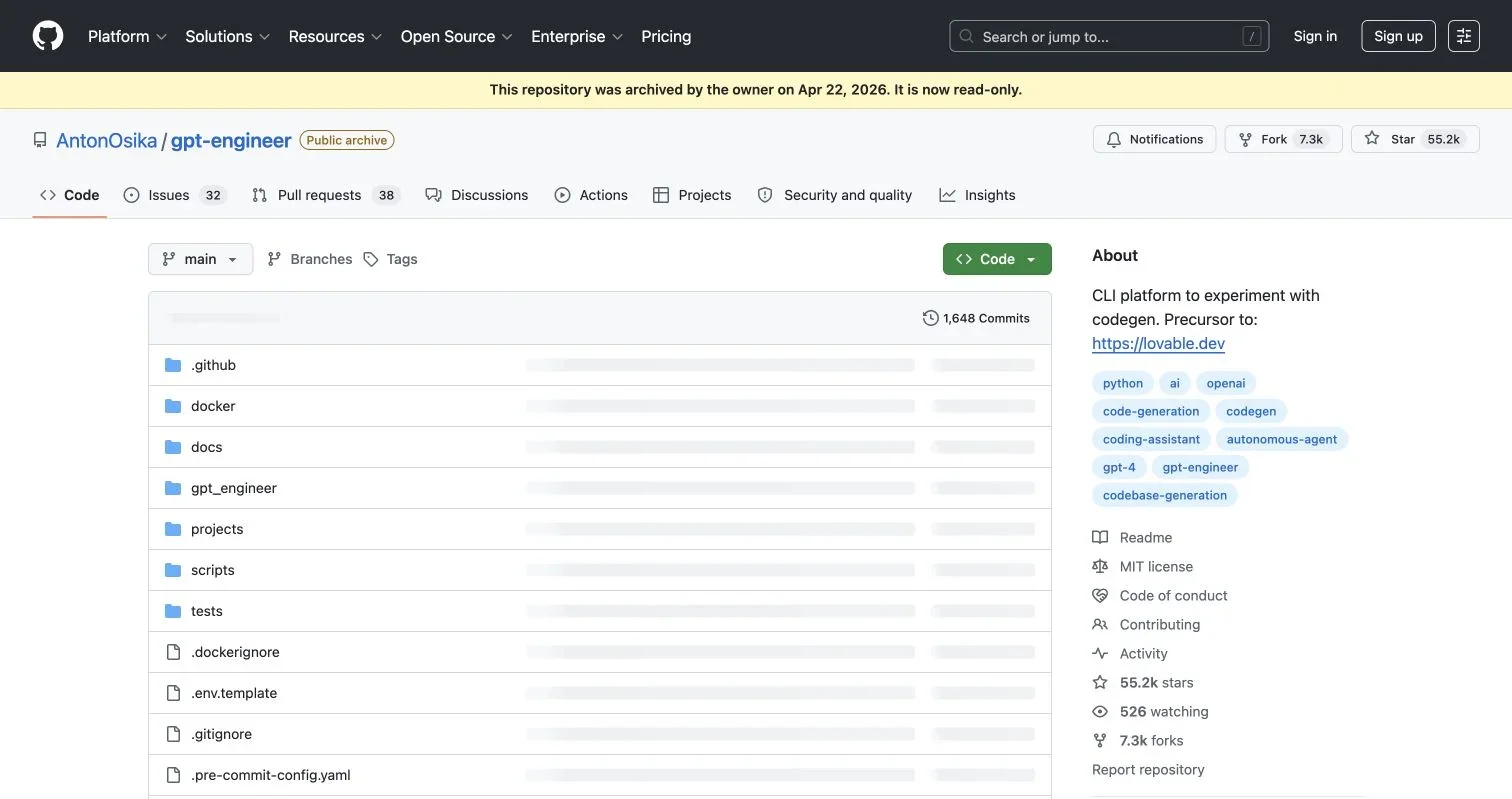
Source page reviewed in Chrome during article research. Follow the image link for the current page.
GPT Engineer Architecture Features and Capability Overview
GPT Engineer is an orchestrated CLI workflow and open-source coding agent, not a continuously autonomous developer. Its behavior comes from Python functions, prompt templates, model calls, file parsers, and an execution environment.
| Capability | Verified setup | Enterprise interpretation |
|---|---|---|
| Planning | A roadmap preprompt forms part of the system prompt |
Model-generated planning, not a deterministic project planner |
| Code generation | The model returns a formatted response that is parsed into a FilesDict |
Generated files require review and testing |
| Existing-code changes | Project files are supplied as context and model output is parsed as diffs | Useful for bounded edits; context size and diff quality remain constraints |
| Entrypoint creation | A second model call asks for a Unix script that installs dependencies and runs the code | Convenient, but the generated script is untrusted code |
| Execution | The CLI displays the script and requests confirmation before running it | Human approval exists, but isolation does not |
| Memory | Logs and prompt templates are stored on disk | This is file-backed state, not durable semantic memory |
| Extensions | Callables, model wrappers, preprompts, memory, and execution classes can be replaced | Flexible for engineers willing to own a fork |
| Governance | Basic execution confirmation and local logs | Insufficient by itself for regulated production use |
The repository README documents a prompt file for GPT Engineer code generation and the -i option for improving an existing project. It also describes custom preprompts and image input. These documented capabilities do not indicate current vendor support.
A roadmap, issue, or old announcement may describe an ambition; only code on the archived main branch represents this version.
Open-Source Coding Agent Use Cases and Poor Fits
GPT Engineer is most useful for disposable, reviewable, contained coding tasks. I would use it as a teaching tool or controlled prototype generator, not on a production monorepo with cloud credentials in the shell.
Good candidate use cases include:
- Generating a small internal proof of concept from a written specification
- Producing starter files for a command-line utility or sample service
- Testing alternative preprompt strategies for code generation
- Studying how model output can be converted into files and diffs
- Running coding-agent experiments against benchmark datasets
- Demonstrating human approval before agent-generated execution
Poor fits include:
- Unattended changes to production repositories
- Systems handling regulated or highly confidential source code
- Automated deployment from generated output
- Large repositories that cannot fit into the selected model’s usable context
- Workflows requiring formal change approvals, separation of duties, or complete audit evidence
- Environments where arbitrary package installation or shell access is prohibited
| Scenario | Fit | Reason |
|---|---|---|
| Weekend prototype in an isolated container | Reasonable | Small scope and recoverable output |
| Internal developer experiment | Conditional | Add model-data rules, logging, and code review |
| CI job that opens draft changes | Conditional | Disable execution and add scanning plus approval gates |
| Direct production hotfix | Poor | Generated changes and commands can be incorrect or unsafe |
| Regulated source repository | Poor without major engineering | No built-in enterprise policy, identity, or evidence system |
Repository popularity does not establish business value. Measure whether the tool reduces time to a reviewed result, not how many files or lines it produces.
GPT Engineer Architecture Features and Prompt Flow
The default new-project flow is compact. The CLI loads configuration and prompts, constructs an agent, generates files and an entrypoint, then optionally executes the script. The relevant orchestration appears in cli_agent.py, while generation and execution functions live in steps.py.
flowchart TD
    A[User prompt file or terminal input] --> B[CLI configuration]
    I[Optional image directory] --> B
    P[Default or custom preprompts] --> C[Prompt assembly]
    B --> C
    C --> D[Model adapter]
    D --> E[Generated chat response]
    E --> F[chat_to_files parser]
    F --> G[FilesDict]
    G --> H[Entrypoint prompt with codebase context]
    H --> D
    D --> J[Generated run script]
    J --> K[Display script and request approval]
    K -->|Decline| L[Leave files for review]
    K -->|Approve| M[DiskExecutionEnv]
    M --> N[Local shell subprocess]
    N --> O[stdout, stderr, and local logs]
The diagram is literal: the default path has no hidden fleet of cooperating agents.
-
Input loading: The CLI reads a prompt file or asks interactively, optionally adding content from an image directory.
-
System-prompt assembly: The generation system prompt concatenates the
roadmap,generate, file-format, andphilosophypreprompts. Existing-code mode substitutes an improvement prompt and diff format. -
Model call: The
AIabstraction sends system and user content to the selected model provider. Model messages are recorded in local logs. -
File parsing: The chat-to-files parser processes the final response. Malformed output can produce missing, incomplete, or wrongly named files.
-
Entrypoint generation: A separate call uses the generated codebase to create a Unix script that installs dependencies and runs required components.
-
Execution decision: The program prints the script and, with operator approval, invokes
bash run.shthrough the configured environment.
The architecture is readable but brittle: much of its contract depends on prompt wording and parsable output.
GPT Engineer Code Generation Context and Extension Points
For new projects, GPT Engineer creates the initial files. For improvements, it reads interactively selected files, sends their content with the requested change, and applies parsed diffs. This transparent approach is not a sophisticated retrieval system.
Context considerations include:
- Selection quality: Omitting a dependent file can produce an internally inconsistent edit.
- Token limits: Large source trees may exceed practical model context or become expensive.
- Binary files: The local file-store reader substitutes a marker for content it cannot decode as text.
- Prompt exposure: Included code and images may be transmitted to the configured model provider.
- Generated paths: File-writing code deserves path-validation review before use with hostile or untrusted prompts.
The code offers useful extension points:
| Extension point | What can be replaced | Typical enterprise use |
|---|---|---|
AI abstraction |
Model and chat behavior | Route requests through an approved model gateway |
PrepromptsHolder |
System prompt files | Add coding standards and output conventions |
| Code-generation callable | Default generation step | Insert planning, validation, or structured output |
| Improvement callable | Diff-generation logic | Add repository-aware retrieval or patch validation |
| Process-code callable | Entrypoint execution step | Replace local execution with a sandbox job |
BaseMemory setup |
Logs and stored state | Send auditable events to controlled storage |
BaseExecutionEnv setup |
Command runtime | Use an ephemeral container or restricted worker |
The custom-steps module includes experimental lite generation, clarification, and self-healing, none of which establishes production reliability. Self-healing loops can multiply model calls and execution attempts yet still converge on the wrong behavior.
Open-Source Coding Agent Prerequisites, Integrations, and Cost
The archived README lists Python 3.10 through 3.12 as supported and documents installation with pip, or development setup with Poetry. It requires model credentials and can run through Docker or Codespaces. With maintenance stopped, revalidate compatibility with current SDKs and model APIs.
A minimum controlled setup needs:
- A dedicated workstation, VM, or preferably an ephemeral container
- A supported Python runtime and pinned dependencies
- Access to an approved model endpoint
- A narrowly scoped model credential supplied at runtime
- A disposable working directory or isolated repository clone
- Network egress rules for model and package endpoints
- Human review, tests, secret scanning, and dependency scanning
This MIT-licensed repository has no published subscription price, but operating it still costs money. Budget for:
- Model input and output usage
- Engineering time to maintain a fork
- Container or worker infrastructure
- Security review and monitoring
- Evaluation datasets and regression testing
- Incident response for unsafe or incorrect generated output
Do not estimate cost from prompt length alone: improvement mode may send substantial source context, and clarification or repair flows may make several calls.
GPT Engineer Architecture: Governance, Security, and Execution Boundaries
The most consequential setup detail sits in DiskExecutionEnv. It launches commands through a local subprocess with shell=True and the generated project’s directory as the working directory. The entrypoint requires operator approval before execution, but it is not sandboxed.
A generated script may attempt to:
- Install packages or execute package lifecycle scripts
- Read files accessible to the current user
- Use credentials present in environment variables
- Reach internal or public network services
- Start long-running processes
- Modify files beyond the intended project if shell commands permit it
The approval prompt is a decision boundary, not a security boundary. A reviewer may miss a malicious dependency, encoded command, destructive glob, or subtle exfiltration instruction.
| Control area | Repository behavior | Production control to add |
|---|---|---|
| Execution approval | Interactive yes-or-no prompt | Change ticket plus authorized reviewer |
| Isolation | Local working directory | Rootless ephemeral container or microVM |
| Network | Inherits host access | Default-deny egress with allowlisted endpoints |
| Credentials | Environment-based API keys | Short-lived secrets with workload identity |
| Source exposure | Context sent to model provider | Classification rules and approved provider terms |
| Audit | Local prompt and response logs | Immutable centralized events with retention policy |
| Output assurance | Human inspection | Tests, SAST, dependency, license, and secret scans |
| Maintenance | Archived repository | Named internal owner and patched fork |
Running a generated dependency installer alongside production credentials is unsafe; the fix is architectural, not another warning.
Open-Source Coding Agent Evaluation and Rollout Checklist
Begin evaluation with a narrow hypothesis such as “reduce time to create a reviewed service scaffold,” not “automate software engineering.”
- Fork the archived repository and pin the exact commit, Python version, dependencies, and model configuration.
- Replace local execution with an isolated, disposable runtime. Disable outbound network access unless a test explicitly requires it.
- Create a representative evaluation set containing ordinary tasks, ambiguous requests, malicious prompt content, and dependency-installation cases.
- Require generated changes to enter the normal review process as an untrusted contribution.
- Measure task completion, reviewer effort, defects, unsafe command rate, model cost, and elapsed time.
- Re-run the evaluation after every model, prompt, parser, or dependency change.
| Item | What to Check | Why It Matters |
|---|---|---|
| Repository status | Archived upstream and internal ownership accepted | Security and compatibility fixes are now your responsibility |
| Execution isolation | No host credentials, restricted filesystem, limited egress | Generated commands are untrusted |
| Model governance | Approved endpoint, retention terms, regional controls | Source code may leave your environment |
| Context policy | File exclusions and classification rules tested | Selection can expose secrets or regulated code |
| Approval flow | Reviewer can inspect diffs and commands | A terminal prompt alone is too weak |
| Quality gates | Tests and security scanners block promotion | Plausible code can still be wrong |
| Cost controls | Per-task limits and usage telemetry exist | Repair loops and large context can raise spend |
| Rollback | Runs use branches or disposable clones | Failed generations must be easy to discard |
| Success metrics | Baseline and target defined before pilot | Output volume is not a business outcome |
A useful pilot reports review acceptance, median review time, escaped defects, blocked unsafe actions, and cost per accepted change, not lines generated.
Conclusion
The GPT Engineer open-source AI coding agent architecture is a compact and instructive design: prompt templates guide a model, parsers convert responses into files or diffs, interchangeable components provide extension seams, and a local execution environment can run a generated entrypoint after human confirmation.
Its strengths are readability, hackability, and reference value; its weaknesses are prompt-dependent contracts, broad local execution, limited governance, context-scaling problems, and an archived upstream.
For enterprises, this is not a supported agent platform. Teams willing to maintain a fork, replace the runtime, control model access, and apply software-delivery gates can use it to study early coding-agent design.
Frequently asked questions
Can GPT Engineer be used safely on a production repository?
Not without substantial additional controls. Use a disposable clone or branch, isolate execution, remove ambient credentials, restrict network access, and require normal code review and automated security checks before merging any output.
What happens if I approve the generated run script?
GPT Engineer runs the script through a local shell with the project directory as its working directory. Because the script may install packages, access files, use environment variables, or contact network services, it should be treated as untrusted code and executed only inside a restricted container or similar sandbox.
How should I choose files when improving an existing project?
Include the target files along with their key dependencies, tests, configuration, and relevant interfaces. Exclude secrets, regulated data, generated assets, and unrelated files; incomplete context can lead to inconsistent changes, while excessive context increases cost and may exceed model limits.
What internal work is required now that the repository is archived?
An organization adopting GPT Engineer should assign an owner to maintain a fork, patch vulnerabilities, pin dependencies, and verify compatibility with current model APIs. It should also establish regression tests for changes to models, prompts, parsers, and runtime components.
Can GPT Engineer send proprietary source code to an external model provider?
Yes, selected source files, prompts, and optional images may be included in model requests. Before use, confirm the provider’s data retention, model training, regional processing, and contractual terms, and enforce rules that prevent sensitive files from entering the model context.
How can teams control model and infrastructure costs?
Set per-task token and call limits, restrict the amount of source context, and monitor clarification or repair loops that can trigger repeated requests. Measure cost per reviewed and accepted change rather than cost per generated file or line of code.
Which metrics indicate whether a GPT Engineer pilot is successful?
Track task completion, review acceptance, median reviewer time, escaped defects, unsafe commands blocked, and cost per accepted change. Compare these results with a baseline workflow so that faster generation is not mistaken for improved delivery.
Is GPT Engineer still actively maintained?
No. The GitHub repository states that it was archived on April 22, 2026 and is read-only. Teams may fork the MIT-licensed code but must maintain it themselves.
- Upstream fixes should not be expected
- Dependency and model compatibility require internal testing
- Roadmap documents should not be treated as commitments
Does GPT Engineer plan before writing code?
Its system prompt uses a roadmap preprompt to provide planning-oriented instructions. The default pipeline has no deterministic planner with validated tasks, dependencies, and completion states.
How does GPT Engineer receive existing code context?
Improvement mode can interactively select project files before sending their content to the model. This is direct context assembly, not an indexed retrieval service with access-control-aware search.
Does it execute generated code automatically?
The default entrypoint prints the generated shell script and, with operator approval, runs it locally through a shell subprocess. Enterprises should move this into a restricted disposable environment.
Can GPT Engineer use models other than OpenAI models?
The archived README documents OpenAI API, Azure OpenAI, Anthropic, and alternative or local-model setup paths. Before a pilot, verify each provider integration against pinned SDK versions.
Is GPT Engineer free to deploy?
The repository uses the MIT license and does not publish a deployment subscription price. Model usage, infrastructure, security, testing, and maintenance still cost money.
What is the safest way to evaluate it?
Start with synthetic code in an isolated fork and disposable runtime. Remove ambient credentials, restrict network access, retain full model and execution logs, and require review plus automated scanning before accepting any output.